
What Tap Water Does to Your Espresso Machine (and How Distilled Saves It)
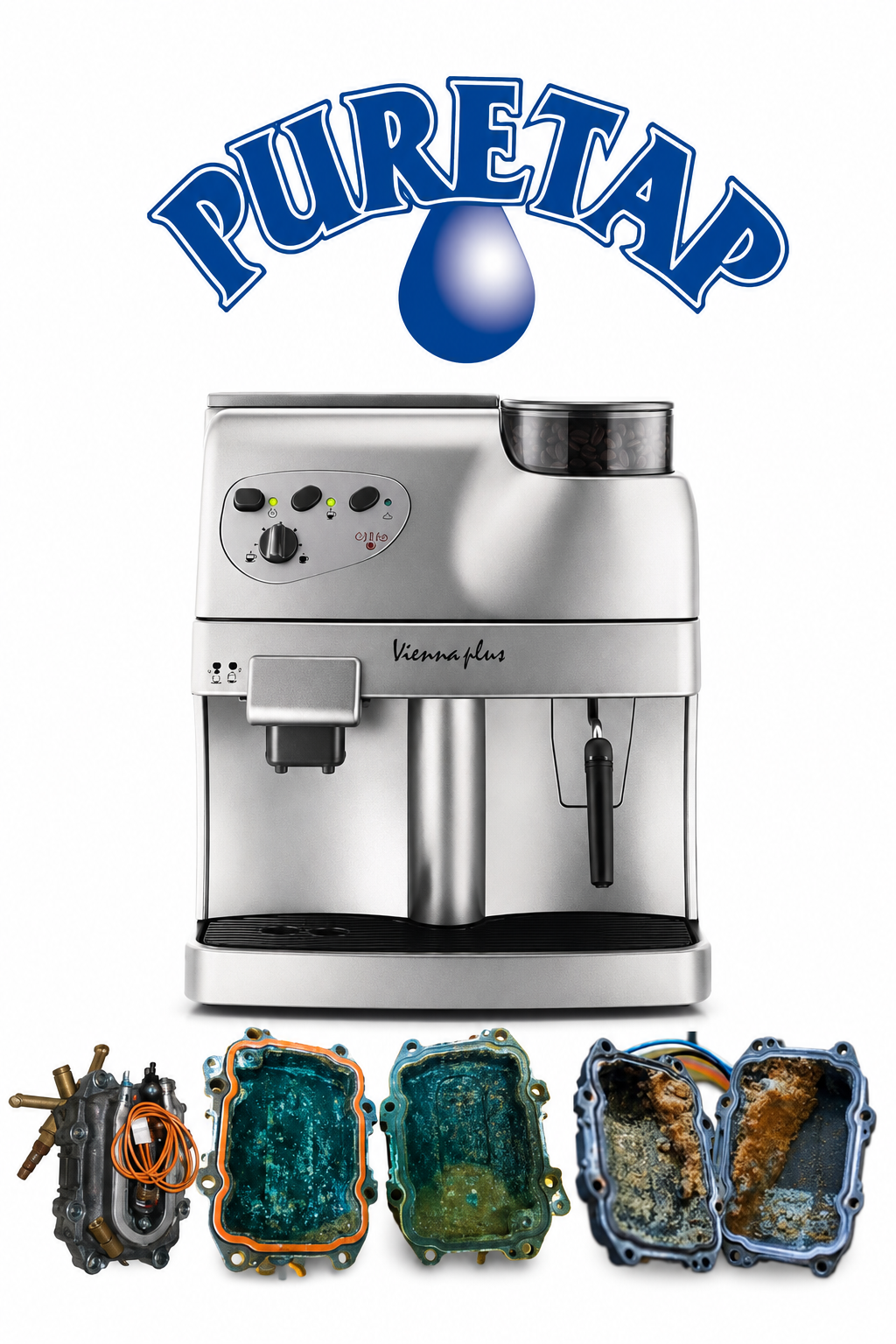
The photo at the top of this post is what the inside of a two-year-old Saeco espresso boiler looks like after running exclusively on filtered tap water. Not unfiltered tap, filtered. The owner did everything most coffee guides recommend: a carbon filter on the water, regular descaling on the manufacturer schedule. Two years in, the seal gasket is encrusted in blue-green copper oxide, the inner walls are coated in brown sludge that’s part biofilm and part mineral, and the brass fittings are pitted. The machine still works, barely. It will need a full boiler rebuild before it sees year three.
This isn’t a worst-case scenario. It’s what happens to any espresso machine, Keurig, Nespresso, or pod brewer in the GTA running on the standard local water supply over a few hundred brew cycles. The chemistry is straightforward, the damage is cumulative, and the fix is almost always cheaper than the repair. This post covers what’s actually going on inside the boiler, why distilled water changes the equation, and how to handle the one real objection serious coffee drinkers raise, that distilled water makes coffee taste flat.

What’s actually growing inside your espresso machine
An espresso machine boiler is, structurally, a small pressure vessel that you cycle to ~95°C several times a day. Water comes in cold, gets heated to brewing temperature, exits as steam or pressurised hot water, and the cycle resets. Three things happen during that cycle that don’t happen in a kettle:
- The water sits inside the boiler between cycles. A kettle empties to dryness; a boiler stays full. Warm, mineral-rich water held in a closed metal vessel between brews is exactly the environment biofilm needs to colonise.
- The boiler is metal, usually brass or copper internally. Hot mineralized water sitting in contact with brass slowly leaches copper into solution, then deposits it again on the walls as copper hydroxide and copper carbonate. That’s the blue-green tint in the photo.
- Scale forms inside-out, not just on the heating element. Calcium and magnesium precipitate out of solution as the water heats. They coat the heating element, narrow the brew pathways, and crust the gaskets that maintain pressure. Once a gasket scales over, it stops sealing reliably, which is why two-year-old machines start dripping from places that used to be tight.
Manufacturers know this. Most home espresso manuals recommend descaling every three to six months, depending on water hardness and use frequency. In the GTA, where municipal water typically runs 120 to 250 mg/L as calcium carbonate (see our guide to hard water in the GTA), three months is the safer end of the interval. Skip it for a year and you’ll see what the photo shows, scale that’s no longer responsive to standard citric-acid descaling solutions because it’s bonded with biofilm and metal oxides, and a heating element that needs noticeably longer to reach temperature because it’s insulated by the deposit.
The temperature problem most users don’t notice
Scale acts as thermal insulation. A heating element designed to bring water to 95°C inside a clean boiler will struggle to reach 88 to 90°C inside a scaled one. The difference doesn’t sound like much, but it’s enough to noticeably under-extract the espresso shot, sour, thin, missing the body the machine was capable of when new. Most users blame the beans, the grind, or the technique. The actual culprit is sitting inside the boiler, invisible until you pull the unit apart.
What changes when you run distilled
Distilled water carries zero hardness, no calcium, no magnesium, nothing to leave behind when it heats and evaporates. Inside the boiler, that means no scale ring forms on the heating element, no chalky build-up coats the gaskets, and the brew pathways stay their original diameter. The biofilm story is more nuanced, biofilm needs a food source, and minerals are part of what microbial colonies feed on, so distilled meaningfully slows biofilm growth but doesn’t eliminate it entirely. A monthly hot-water flush handles the rest.
For the descaling schedule specifically, the difference is dramatic. Machines running on distilled water plus an occasional rinse typically need a full descaling treatment every 12 to 24 months instead of every 3 to 6, and even then, what comes out is light and easy to remove rather than the bonded scale-and-biofilm composite that ruins gaskets. Over a 10-year machine life, that’s roughly 30 fewer descaling cycles, plus the avoided cost of a boiler rebuild somewhere around year 4 or 5.
“But doesn’t distilled make coffee taste flat?”
Here’s where the honest answer is more interesting than the marketing answer. Pure distilled water is, by itself, not optimal for coffee extraction. The Specialty Coffee Association publishes a Water Standard for brewing, the target range is 75 to 250 ppm total dissolved solids, 50 to 175 ppm calcium-carbonate hardness, and 40 to 70 ppm alkalinity, with a sweet spot around 150 ppm hardness. Distilled comes in at 0 across the board. That’s a problem for taste because dissolved minerals, magnesium in particular, actively participate in extracting flavour compounds from the coffee grounds. Strip the minerals and the cup tends to taste under-extracted: muted, slightly sour, missing the body and sweetness a well-mineralized brew brings out.
So the cleanest version of the truth is: distilled water protects the machine but doesn’t make the best cup of coffee on its own.

The fix is also straightforward. Serious espresso users mix distilled with a small, measured remineralization pack, products like Third Wave Water, Lotus, or homemade mixes of food-grade magnesium sulphate and sodium bicarbonate, bringing the water to roughly the SCA target. The result is water that protects the boiler and extracts a balanced shot. This is what most specialty cafés and home espresso enthusiasts have been doing for the last decade. It’s not new; it’s just not widely known outside the coffee-obsessed corners of the internet.
What about the chlorine and chloramine argument? That one’s straightforward. Municipal chlorination is essential for safe tap water, but chlorine and chloramine both carry over into the cup and produce off-flavours described variously as papery, plasticky, or chemical, easy to taste, hard to ignore once you notice it. Distilled has neither, which is one of its quieter advantages. Even users who add minerals back start from a chlorine-free baseline.
The pod-machine case is simpler
For pod-based machines, Nespresso, the older Keurigs, single-serve units that brew through a pre-measured capsule, the water-chemistry-versus-extraction tradeoff matters less. The capsule controls the contact time, the grind, and the pressure profile so tightly that the difference between distilled and remineralized water inside the cup is, for most users, hard to detect. The machine longevity benefit, on the other hand, is identical to espresso. So for pod brewing, plain distilled is usually fine.
Two caveats worth knowing about pod machines specifically:
- Keurig 2.0 and newer have conductivity-based water level sensors, they read distilled as “empty” even when the reservoir is full. This is the same sensor limitation we cover in our post about appliances that warn against distilled water. Pre-2.0 Keurigs don’t have this issue. If you’re not sure which generation you have, fill the reservoir with distilled and see whether the “Add Water” light comes on, if yes, you’re on a 2.0 or newer, and either filtered tap or a switched fill strategy is the answer.
- Nespresso’s manufacturer guidance is genuinely mixed. Some Nespresso documentation recommends against distilled on the grounds that ultra-pure water can be slightly more chemically reactive with the machine’s internal metals over time. The effect is real but small at coffee-machine temperatures and contact times, and in practice most Nespresso users who switch to distilled report no problems and a dramatic drop in scale build-up. The conservative call is distilled-plus-a-pinch-of-minerals; the pragmatic call is plain distilled and accepting any minor accelerated wear as preferable to the alternative.
What this looks like in practice
For most GTA households running an espresso machine daily, the simplest move is to fill the reservoir from a 4 L jug of Morning Mist distilled water kept under the sink. If you take espresso seriously, pulling shots for daily ritual or for guests, adding a sachet of a remineralization product like Third Wave Water (sold at most specialty coffee retailers) is the upgrade that completes the picture. The added cost works out to a few cents per shot and the cup improvement is immediately noticeable.
For pod machines and Keurig pre-2.0 models, plain distilled is the right call. For Keurig 2.0+, see the conductivity-sensor caveat above.
Cafés and restaurants in the GTA have the same problem at much higher volume, a commercial espresso machine pulling 200 shots a day in unfiltered hard water can need a boiler service within 18 months. We supply distilled water to cafés, restaurants, and commercial kitchens across the GTA on regular delivery schedules; for that volume, wholesale pickup and delivery is usually the most economical route.
Quick reference
- Espresso machines need protection from GTA water. Scale, biofilm, and copper oxidation cumulate over months. The Saeco photo in this post is what two years of filtered tap looks like inside.
- Distilled water dramatically slows the damage. No hardness, no scale, light biofilm growth at most. Descaling cycles drop from every 3 to 6 months to every 12 to 24.
- For serious espresso, add minerals back. Pure distilled mutes flavour extraction; distilled plus a measured remineralization hits the SCA target (~150 ppm hardness) and brews properly.
- For Nespresso and pre-2.0 Keurig, plain distilled is fine. Pod brewing isn’t sensitive enough to water profile to need remineralization, and the machine longevity gains are real.
- Keurig 2.0+ has conductivity sensors that can’t see distilled. See our separate post on this.
- Chlorine and chloramine in tap water carry into the cup. Distilled has neither.
Order distilled water for delivery in the GTA
If your espresso machine is more than a year old and you’ve been running it on tap, the boiler is already on the way to looking like the photo. Switching to distilled now won’t reverse the damage already done, but it will stop the progression and dramatically extend whatever life the machine has left. A 4 L case of Morning Mist covers most home espresso users for two to three weeks. Get in touch and we’ll set up a delivery schedule that fits, household, café, or full commercial kitchen.
Puretap has been distilling water in the GTA since 1986. Same family business, same Canadian-made product, used in everything from CPAP humidifiers to laboratory glassware to the espresso machines that quietly hold our mornings together.


