
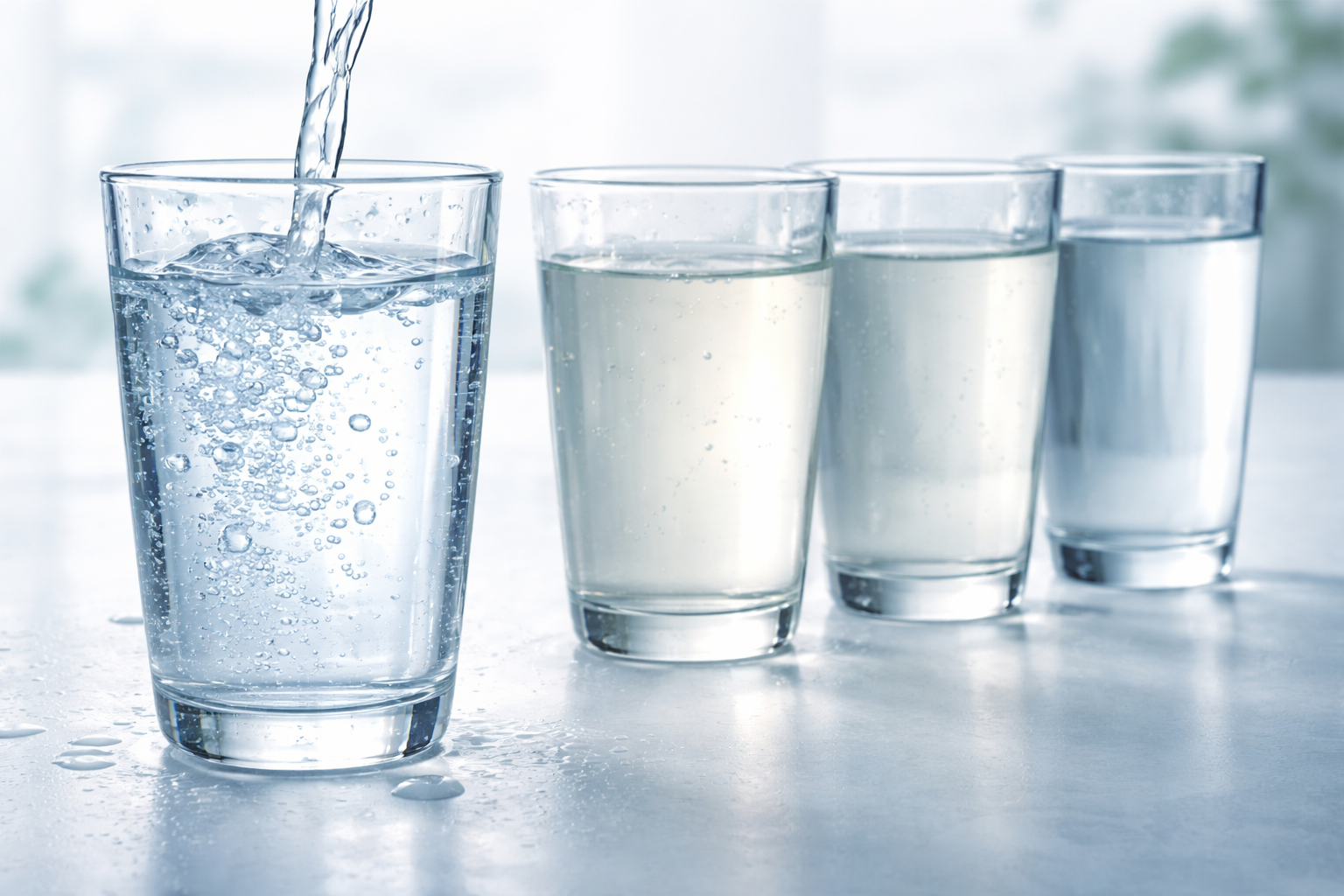
Distilled Water vs Spring Water vs RO vs Filtered: Which Is Best?
The short answer. If the water goes into equipment, use distilled. If it goes into a glass, spring or filtered is fine and cheaper. Reverse osmosis sits in between and costs you three to four litres of waste for every litre it makes. Everything below is the long version, with the numbers.
The comparison, in one table
Total dissolved solids, or TDS, is measured in parts per million. It is the single most useful number for comparing water, because it tells you how much of anything other than water is in the water. These are our own figures, measured in Mississauga.
| Type | Typical TDS | Consistency | Waste | Best for |
|---|---|---|---|---|
| Tap | 180 to 320 ppm | Varies by municipality | None | Washing, general use |
| Filtered | 80 to 250 ppm | Falls off as the filter loads | None | Taste, chlorine removal |
| Spring | 80 to 250 ppm | Seasonal | None | Everyday drinking |
| Purified | Anywhere from 5 to 250 ppm | Depends entirely on method | Varies | Depends, see below |
| Reverse osmosis | 10 to 50 ppm | Declines with membrane age | 3 to 4 L per 1 L made | Home drinking, middle ground |
| Distilled | 0 to 5 ppm | Same every batch | None at point of use | Equipment, medical, lab |
Tap water: treated, not pure
Municipal water in Ontario is disinfected and it is safe to drink. Safe and pure are different claims.
Treatment is built to kill pathogens and control turbidity. It is not built to remove dissolved solids, and it was never designed with today’s contaminant list in mind. A 2023 United States Geological Survey study detected PFAS, the group of industrial compounds usually called forever chemicals, in roughly 45 per cent of tap water samples tested. The National Academies reviewed PFAS exposure in 2022 and linked it to thyroid dysfunction, elevated cholesterol, certain cancers and lower birth weight. In 2024 the US EPA set enforceable limits for several PFAS compounds as low as four parts per trillion, which gives a sense of how little of this material is considered acceptable.
Lead and copper are the other quiet problem. Both leach from ageing service lines and household plumbing rather than arriving at the treatment plant, which is why a municipality can meet every standard at the reservoir and still deliver metal to a tap in an older house.
When we test GTA tap samples in our own facility we typically read between 180 and 320 ppm, varying by municipality and by season. That is not a fault. It is what treated municipal water is.
Filtered water: better taste, same dissolved load
A carbon or ceramic filter, whether in a jug, a fridge door or under the sink, adsorbs chlorine and traps sediment. It makes water taste noticeably better and it is the cheapest improvement available.
What it does not do is change the dissolved mineral content much. Filtered water typically comes in between 80 and 250 ppm, because dissolved calcium and magnesium pass straight through carbon. This is why filtered water still leaves scale in a kettle and still ruins a humidifier over time. The taste problem is solved. The mineral problem is not.
Filters also degrade silently. A cartridge past its rating can stop adsorbing and, if it stays wet and warm, become a place bacteria grow. The performance curve is invisible from the outside, which is the real weakness of filtration.
Spring water: natural, mineral bearing, seasonal
Spring water comes from an underground source and carries the minerals of the rock it moved through. Calcium and magnesium in particular are what give spring water its taste, and for most people that taste is the point.
Typical TDS runs 80 to 250 ppm. The honest caveat is that a natural source is a natural system: rainfall, snowmelt, soil conditions and surrounding land use all move the numbers through the year. That is fine for drinking, where the variation is a matter of taste. It is a problem anywhere consistency matters, which is why a daycare or a lab that needs the same water every week tends to move away from it.
Our spring water is Canadian sourced and bottled at our Mississauga plant.
Purified water: a label, not a method
This is the term that causes the most confusion, so it is worth being blunt about it.
Purified is a description of an outcome, not of a process. Water sold as purified may have been distilled, put through reverse osmosis, deionized, or filtered to a standard. Two bottles both marked purified can differ by fifty times in dissolved solids depending on which of those was used.
If a label says purified and does not say how, the only way to know what you are buying is to ask, or to read the ppm. If it does not state a ppm figure either, assume the number is not flattering.
Reverse osmosis: strong performance with a maintenance bill
An RO system forces water through a semi permeable membrane that rejects most dissolved solids. A healthy membrane removes 90 to 95 per cent of TDS, bringing typical output to somewhere between 10 and 50 ppm. Fresh membranes sit at the low end of that. Old ones drift up.
It wastes water. A domestic RO unit sends three to four litres to the drain for every litre it produces. Over a year in a household that adds up to thousands of litres, and it is the reason RO is a harder sell than it looks on efficiency grounds.
Its performance is a maintenance schedule. Membranes and pre filters have to be changed on time. A neglected system does not stop working in an obvious way, it just quietly gets worse, and the storage tank downstream is a place biofilm can establish. RO done properly is very good. RO done casually drifts back toward filtered water while you assume it is still doing its job.
Distilled water: the only one that is repeatable
Distillation boils water into steam and condenses the steam back into liquid. Everything that does not vaporise, which is essentially every dissolved solid, every metal, and PFAS compounds among them, is left behind in the boiling chamber.
The result is water at 0 to 5 ppm. Not roughly. Every batch, because the physics does not have a maintenance schedule attached and there is no membrane to age.
That repeatability, rather than the purity number on its own, is why hospitals, pharmacies, laboratories and manufacturers specify distilled. They are not buying clean water. They are buying the certainty that next month’s water is identical to this month’s.
How we make it
- Vaporise. Source water is boiled. Metals, salts and PFAS stay in the chamber.
- Condense. The steam is cooled back to liquid in a closed system.
- Test. Each batch is checked to confirm 0 to 5 ppm TDS.
- Seal. Held in sterile stainless tanks, then bottled and sealed for delivery.
All of it happens at our plant on Verbena Road in Mississauga, in the same building where we blow mould the bottles it goes into. See our 18 L distilled water.
So which one should you actually use
The question is not which water is best. It is which water is right for the job in front of you.
| If it is for | Use | Why |
|---|---|---|
| Drinking every day | Spring or filtered | Taste, and the minerals are pleasant |
| CPAP machines | Distilled | Minerals crust the humidifier chamber |
| Steam irons and humidifiers | Distilled | Scale is what kills them |
| Autoclaves and sterilizers | Distilled | Specified by the equipment maker |
| Dental and medical equipment | Distilled | Consistency is a compliance requirement |
| Espresso and coffee machines | Depends on the machine | Some want minerals for extraction, some forbid them. Read the manual |
| Car batteries and cooling systems | Distilled | Minerals conduct and corrode |
| Laboratory and industrial process | Distilled | Repeatability |
| Cooking | Any of them | Genuinely does not matter much |
The missing minerals question
The most common objection to distilled water is that removing minerals removes something you need.
The nutritional arithmetic does not support it. Drinking water supplies well under one per cent of the essential minerals in a typical diet. The calcium in a glass of mineral water is a rounding error next to the calcium in one serving of dairy, leafy greens or almonds. You are not going to make up a mineral deficiency through your water, and you are not going to cause one by removing them.
What removing them does do is stop the scale that shortens the life of every appliance that heats water.
What our customers actually found
| Customer | Problem | After switching to distilled |
|---|---|---|
| Toronto café | Scale in espresso machines | 60 per cent fewer service calls |
| Mississauga dental clinic | Unstable RO readings | Autoclave maintenance halved |
| Local bakery | Inconsistent yeast proofing | Consistent dough |
| Medical lab | Drifting TDS | Uniform 0 to 5 ppm |
| Brampton family | Kettle scale, metallic coffee | Scale gone in two weeks |
Notice the pattern. Almost none of these are about health. They are about equipment, cost and consistency, which is where distilled water earns its money.
Hard water is the same problem upstream
Most of the GTA sits on hard water, and if scale is your issue then distilled water in the appliance is only half the answer. The other half is treating the water coming into the building. Our guide to water softener salt covers what to buy and why the type matters.
Buying it in quantity
If you are supplying an office, a clinic, a refill operation or a job site, the unit economics change completely and the question becomes freight rather than purity. We deliver across the GTA and offer free pickup at 950 Verbena Road. See wholesale and pickup supply, or empty bottles by the skid if you are filling your own.
Decided on distilled? Our guide to where to buy distilled water in the GTA compares every option on price per litre.
Frequently asked questions
Which water has the lowest ppm?
Distilled, at 0 to 5 ppm. Reverse osmosis is next at 10 to 50 ppm depending on membrane condition. Spring and filtered both typically run 80 to 250 ppm, and GTA tap water runs 180 to 320 ppm.
Is distilled water safe to drink every day?
Yes. It is free of chlorine, fluoride, heavy metals and PFAS, and contains nothing but water. The mineral content of drinking water is nutritionally negligible in a normal diet, so removing it does not create a deficiency.
Does distillation remove PFAS?
Yes. PFAS are dissolved compounds that do not vaporise, so they stay behind in the boiling chamber. Distillation is among the most effective removal methods available.
What is the difference between purified and distilled water?
Distilled describes a specific process. Purified describes an outcome and could mean distillation, reverse osmosis, deionization or filtration. All distilled water is purified. Most purified water is not distilled.
Is reverse osmosis as good as distillation?
Close on a good day, and not repeatable. A fresh membrane reaches 10 to 30 ppm. An old one drifts upward without any obvious sign, and the system wastes three to four litres for every litre it makes.
Which water should I put in my humidifier or steam iron?
Distilled. Minerals in tap, spring or filtered water are what leave white dust and scale, and they are the usual reason these appliances fail.
How pure is Puretap distilled water?
Every batch is tested to confirm 0 to 5 ppm total dissolved solids, vaporised, condensed and sealed in a sterile environment at our Mississauga plant.
References
- U.S. Geological Survey. Tap water study detects PFAS forever chemicals across the US. 2023.
- National Academies of Sciences, Engineering and Medicine. Guidance on PFAS Exposure, Testing and Clinical Follow Up. 2022.
- National Institutes of Health. PFAS Health Effects Review. 2024.
- Health Canada. Guidelines for Canadian Drinking Water Quality. 2023.
- World Health Organization. Guidelines for Drinking Water Quality, 4th edition. 2022.
- U.S. Environmental Protection Agency. PFAS National Primary Drinking Water Regulation Final Rule. 2024.
This article is general educational information reflecting Puretap Water Distillers Ltd.’s testing experience and reading of current research. It is not medical advice. Speak to a qualified healthcare professional about specific health concerns. Puretap makes no claim that distilled water prevents or treats any disease.
Puretap Water Distillers Ltd. has been Canadian owned and family run in Mississauga since 1986. We distil our own water and blow mould our own bottles at 950 Verbena Road. Delivery across the GTA, free pickup at the plant. Call 905 670 7400.


