Distilled, Spring, and Purified Water: What’s the Difference?
“Distilled, spring, purified” — three labels sit side by side on the shelf, the prices are close, and most people just grab whichever one looks familiar. But the three are made in genuinely different ways, and the differences matter once the water leaves the bottle and goes into a kettle, a humidifier, a CPAP machine, or a baby’s bath. This is a plain guide to what separates them, and how to pick the one your task actually calls for.
The short version
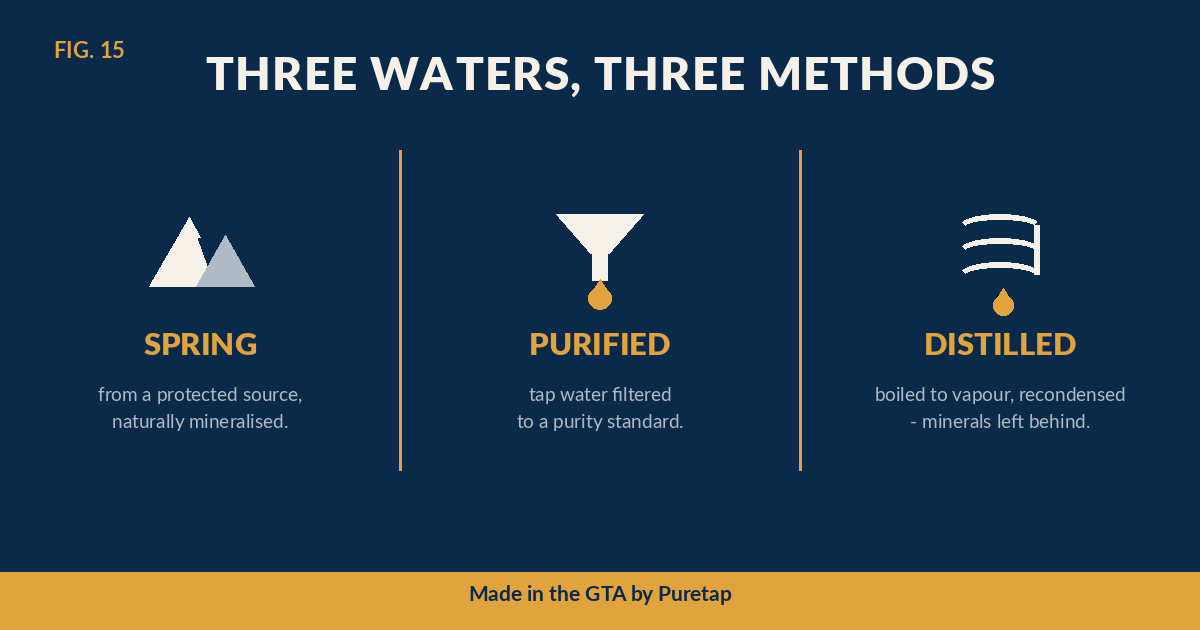
Spring water is collected from an underground source and lightly filtered — it keeps its natural minerals. Purified water is tap or source water run through a treatment process (often reverse osmosis or carbon filtration) until it meets a purity standard — most minerals are reduced but not always removed. Distilled water is boiled to steam and re-condensed, which leaves nearly everything else behind — minerals, metals, and most dissolved solids. Of the three, distilled is the most consistent and the most predictable, which is exactly why appliances and equipment so often ask for it by name.
Spring water: water with its minerals left in
Spring water comes from an underground source that flows to the surface on its own. A reputable bottler filters it to remove sediment and treats it so it is safe to drink, but the goal is to keep the water close to how it came out of the ground — including its natural mineral content. Those minerals are what give different spring waters their slightly different taste.
That makes spring water a fine everyday drinking choice for most households. The minerals are also the reason it is not the right pick for a steam iron or a humidifier: every litre that boils away or evaporates leaves its minerals behind as scale. For drinking it is a feature; for equipment it is the start of a maintenance problem. If spring water is what you are after, our complete guide to spring water covers sourcing, taste, and delivery across the GTA.
Purified water: a process, not a source
“Purified” describes what was done to the water, not where it came from. The starting point can be a municipal supply or any other source; it is then treated — typically reverse osmosis, deionization, carbon filtration, or a combination — until it is clean enough to carry the label.
The catch is that “purified” covers a wide range. Two bottles can both say purified and still have noticeably different amounts of dissolved minerals left in them, depending on the method used. It is reliably clean and safe; it is just not as consistent as distilled, because the label is a floor, not an exact specification. If a task is sensitive to mineral content, “purified” alone does not tell you enough.
Distilled water: the most consistent of the three
Distillation copies what the weather does. Water is heated until it turns to steam; the steam rises, leaving minerals, metals, and most other dissolved solids behind in the boiler; then the steam is cooled and collected as pure water. Because the process depends on physics rather than on how fine a filter is, the result is the same every time — water with almost nothing else in it.
That consistency is the whole point. When an appliance manual specifies distilled water, it is not being fussy — it is relying on the fact that distilled water will not deposit scale, will not leave mineral residue, and will not vary from one bottle to the next. Independent lab testing is how that claim gets checked; you can see the measured results for our own water on the lab analysis page. For a fuller walk-through of how distilled water is made and where it is used, our complete guide to distilled water goes deeper.
So which one do you actually need?
Match the water to the job rather than to habit.
- Everyday drinking and cooking — spring or purified water both work well. This is a taste-and-preference decision more than a technical one.
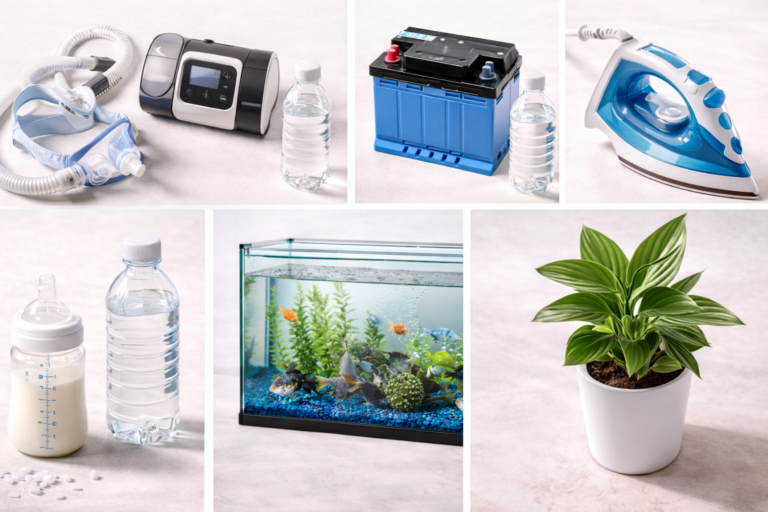
- Steam irons, garment steamers, and humidifiers — distilled. Mineral-free water means no scale building up inside and no white dust settling on the furniture.
- CPAP machines — distilled, and the device manuals say so directly. It keeps the humidifier chamber clean and protects the internal parts.
- Kettles, coffee makers, and espresso machines — distilled dramatically slows scale, though for brewed coffee and espresso there is a flavour nuance worth knowing. We cover it in our espresso-machine guide.
- Car batteries, automotive cooling systems, and other equipment — distilled. Minerals interfere with the chemistry and can shorten the life of the part.
- Aquariums, sensitive houseplants, and lab or hobby work — distilled, because you want to control exactly what goes into the water rather than inherit whatever the source happened to contain.
A simple rule of thumb: if a person is going to drink it, mineral content is mostly a matter of taste. If a machine is going to heat it, evaporate it, or run a chemical reaction with it, you almost always want the minerals gone — and that means distilled.
An honest word about minerals
It is worth being straight about one thing. Because distilled water has had its minerals removed, it is purpose-built water — excellent for the equipment uses above. For day-to-day drinking, plenty of people enjoy distilled water and drink it without a second thought, while others prefer the taste of a mineral water. Most of the minerals a body needs come from food, not water, so this is largely a preference question. The point is simply that “purer” is the right goal for an appliance and an optional one for a glass — choose with the task in mind.
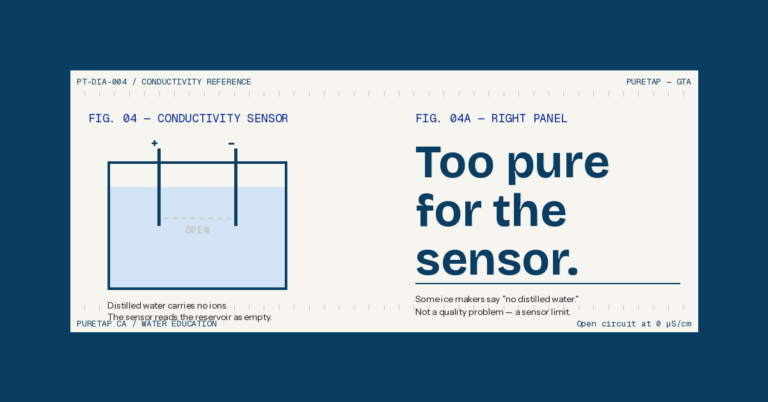
Hard tap water sits at the opposite end of this scale, and across much of the GTA it is genuinely hard. If you want to see what that does to the appliances in a typical home, our hard-water guide walks through the numbers city by city. And if you have ever wondered why a few appliances specifically say not to use distilled water, that has a tidy explanation too.
Canadian-made distilled water, delivered across the GTA
Puretap distils its water here in the Greater Toronto Area, and the finished water is independently lab-tested so the purity claim is something you can actually check. We deliver across the GTA in sizes from 4 L cases up to 18 L bottles for cooler-style dispensers, and pickup is always an option. Whether you are topping up a humidifier, running a CPAP machine, or stocking the cottage for the season, the water arrives the same every time.
Browse the full range on the distilled water page, or get in touch with any questions — we are happy to help you match the right water and the right size to what you are using it for. Reach us at info@puretap.ca or through the contact page, and we will point you in the right direction.